
The Google Ads account of a taxi company in Brussels, with two campaigns: rides around the city and rides to the airport. €700 spent for 109 conversions (calls, WhatsApp, forms). I go over the strategy in place, what the data says and the optimizations to make.

Key figures
- conversions for €700 spent
- 109
- cost of a call, depending on the campaign
- €5.69 to €7.50
- invalid clicks on the airport campaign
- 24%
Airport campaign: about €300 spent.
01
Two campaigns, two intents
Two campaigns, as on every taxi Google Ads account I set up. The first targets standard rides: “taxi Bruxelles”, “réserver un taxi” (book a taxi), “commande taxi” (order a taxi), “taxi Belgique”. It runs on a budget of €25 a day. The second targets the airport: “réserver taxi aéroport” (book an airport taxi), “taxi pour aéroport” (taxi to the airport).
At the time of the video, Google was offering €400 in credit once €400 had been spent. With €800 over a month, you have more than enough to test Google Ads and see whether rides come in.
02
What each campaign brings in
Segmenting by conversion action shows exactly where the contacts come from. The call asset and the button on the website do almost all the work.
The client spent seven hundred euros for a hundred and nine conversions. That is just really, really good.

Who runs these campaigns
The same hands-on management for your account, by a Google Partner
Google Partner
certified in Search, Display and Performance Max
6 years
running Google Ads accounts
€1,000/month to €6,000/day
the budgets I manage
4.8/ 54.8 out of 5, 66 Google reviews
66 Google reviews · Lannkin, the web agency I founded in Canada
Read the reviews on Google Maps (opens in a new window) Pinned video · @albertdelannkinI worked with Gabriel Dubois, the biggest Google Ads client in Belgium.Watch the video on TikTok (new tab)
03
Conversion tracking is essential
This level of detail only exists because the Google Ads conversion tags are installed on the website. They only count traffic coming from the ads, without mixing it with SEO, and they tell the algorithm which keywords and which profiles bring results.
A call costs about €7.50 on the standard campaign and €5.69 on the airport one. That is expensive for a €15 or €20 ride, but a €40, €50 or €60 ride quickly covers the cost, not counting loyal customers and word of mouth. Aiming for a return of 3 to 5 times the spend on the same day is very hard with Google Ads: it is better to judge over a month, with a one-month lag.
You should rather look over a month, actually, with a one-month lag, to see.
04
Responsive ads, with a call asset
One of the two ads was a call-only ad. I do not recommend it: it is far more limited than a responsive search ad, which accepts fifteen headlines and four descriptions. The responsive ad in the other campaign was rated “Excellent”: to get there, you just need to follow the points Google lists.
- Replace the call-only ad with a responsive search ad.
- Fill in the fifteen headlines and four descriptions, using the maximum number of characters.
- Go up to at least 20 images, preferably close-ups (15 to start with here).
- Add a call asset: it shows the phone number directly in the ad.

05
Invalid clicks and impression share
On the airport campaign, the invalid click rate reaches 24%. That is a lot, and Google often underestimates this figure: competition is fierce, part of the traffic is low quality, and competitors click to make you spend.
The airport campaign shows at the top of the page about 20% of the time, and in the very first position less than 10% of the time. On average across both campaigns, 35% of impressions are lost to rank: it is not a budget problem, it is a problem of account or website optimization.
Nearly 50% of impressions are also lost to budget. So I go from €25 to €35 a day for two weeks, then readjust. On large accounts, I increase by 20% per week at most so as not to disrupt the campaigns. Be careful: putting in more money does not guarantee more profitability.
Finally, most of the traffic and the best conversion rates come from mobile: the website must be flawless on a phone.
On Taxi Airport, we have an invalid click rate of around twenty-four percent, which is really a lot.

In a short video
Clics frauduleux sur Google Ads : les astuces pour s'en protéger
Stratégie d'enchères en maximiser les conversions, suivi du taux de clics incorrects, logs via paramètres d'URL, formulaire de remboursement et plusieurs noms de domaine contre les attaques.
Watch on TikTok (2 min 15 s) ↗06
A website too thin for Google
The landing page experience is rated below average: Google considers the website less relevant than those of competitors. It does indeed contain very little text.
The keyword “taxi pour aéroport” (taxi to the airport), the one that spends the most in its campaign, has a Quality Score of only 2 out of 10. You should aim for 10: the higher it is, the cheaper the click. The fix goes through the website: more content, and a dedicated landing page for the airport, with a title such as “Your taxi to Brussels Airport”.
The higher your Quality Score, the less you will actually pay for the click.
07
Excluding the wrong keywords
A broad match keyword triggers many different search terms. Under “taxi pour aéroport”, for example, you find “navette aéroport” (airport shuttle). A Google search shows it: the intent is mostly about public transport, not a taxi. I exclude it, along with buses and anything that does not mention the airport in this campaign.
By default, I also apply a list of five to six hundred negative keywords for taxis, for example:
- bus, rental, carpooling, limousine, van, motorbike;
- jobs, news, newspapers;
- free, cheap;
- tutorial, scam, ranking, figures.
In a short video
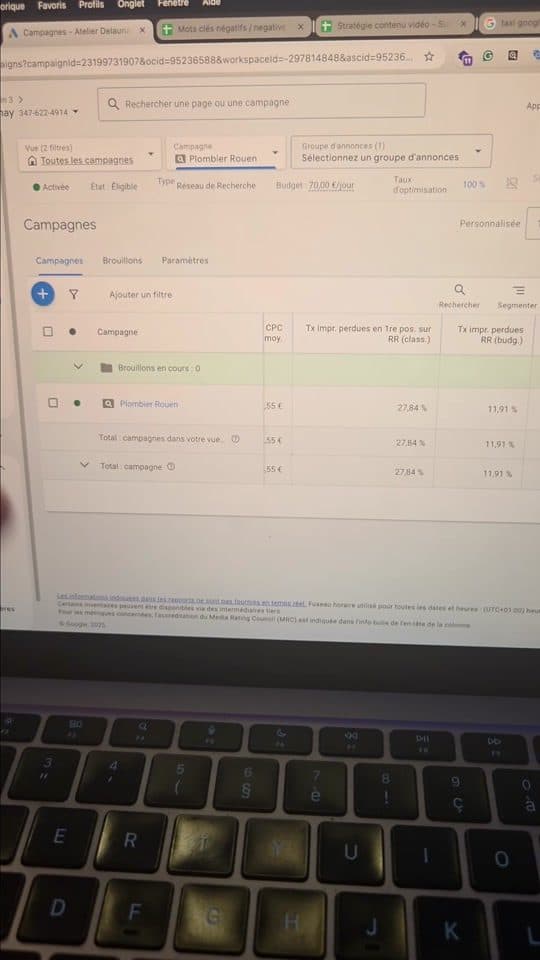
Google Ads plombier : les mots-clés négatifs qui changent tout
Le compte Google Ads d'un plombier, ouvert à l'écran. Le secret présenté : une optimisation continue et de longues listes de mots-clés négatifs, qui écartent les recherches d'emploi, d'arnaque, de marques ou de comparatifs.
Watch on TikTok (1 min 10 s) ↗08
Few keywords, transactional ones first
To get started, I recommend five to ten broad match keywords at most. Choose transactional keywords first, such as airport taxi, which bring in customers in the short term. Long-tail keywords and questions cost less, but convert much less: you quickly spend money for nothing.
On the same topic
Click fraud, CPC, tests: in short videos
A 24% invalid click rate deserves a closer look: here is how to recover that budget.
- 1:24

Fraudulent clicks on Google Ads: how to recover your budget
@albertdelannkin
TranscriptClose
Transcript
- 2:19

Lowering your CPC in Google Ads: keywords, ad and landing page
@albertdelannkin
TranscriptClose
Transcript
- 1:49
19 euros per lead for a plumber: the testing method
@lannkin
TranscriptClose
Transcript
Read the full video transcript(Translated from French)
0:00Hi everyone, my name is Albert Lanne and I am a senior Google Ads consultant. In this video, I am going to show you how I go about optimizing a Google Ads account for taxi rides. First, I will show you the strategy I have already put in place. Then I will show you the different possible optimizations, and finally I will show you other tips you can apply to get better results. At the end of this video, I will show you a trick to permanently exclude a list of keywords I have already put together. These keywords include, for example, anything like bus, rental, carpooling, limousine, van, motorbike, for your taxi business. That way, you can take these five or six hundred keywords and put them straight into your Google Ads account so you never show up on them again. So it is something I strongly recommend. Here is the strategy I put in place for this account. There is a standard acquisition campaign on keywords like Taxi Vert, Taxi Bruxelles, with a budget of twenty-five euros a day, and another campaign for rides to the airport. Note that you can get four hundred euros free once you have spent four hundred euros. That is really good for testing Google Ads over a month: with a budget of eight hundred euros, it is more than enough. It will already let you see how it works and whether you get rides. Here is the website, how it looks.
1:00It is a fairly standard taxi ride website. Personally, I find it very basic, and I, I do not really like this website. There is a lot we could do to improve it. Now, about the Google Ads campaigns, I am going to show you the first campaign I set up. There you go, the Taxi Bruxelles campaign is fairly standard. I am going into the ad. There you go, it is a call-only ad. That is something I do not really recommend, call-only ads. Why? Because these ads will perform worse than a responsive search ad. Responsive search ads are the ads where you can add up to fifteen headlines, four descriptions and four long headlines. They are much more substantial ads and you can do a lot more with them. Here, there you go, we only have, we are very limited in terms of possibilities, and that will directly affect performance. The other ad is a responsive search ad. Here is how it looks. So there you go, we do have the headlines, the descriptions and images. So that is very good. And on top of that, the ad is rated excellent. To get an excellent ad, it is simple: I strongly recommend applying these different points. Google clearly tells you what you need to do to make an excellent ad. For the descriptions, it is important to try to use as many of the eighty characters as possible. It really is important to have fairly long headlines. For images, I strongly recommend adding at least twenty images.
2:01It is really super important. Here, for example, there are only fifteen images. I am going to add a few more to reach the target of twenty images. As a best practice for images, I recommend using rather zoomed-in images to really capture the intent. There you go, now I do have twenty images. Very good. Save. Save. For the logo too, it is super important to highlight the logo. I often run tests. Either pictograms, for example an alarm, an alarm icon, emojis. Sometimes I also test quite a bit with emojis, or else the company logo. But here, since the logo is not great, I preferred to put taxis directly, like this, to show that it really is a taxi. Now, for the targeted keywords, here are the keywords targeted over the last thirty days. I am showing you the data for the last thirty days. “Réserver taxi aéroport” (book an airport taxi), that is for the campaign. So now, here are the keywords for the two campaigns. First campaign: airport taxi. There you go, here you can see the keywords we target for this campaign. Book an airport taxi, book a taxi, taxi to the airport. I am going to show you the other campaign, and then we will analyze the data in more detail, the rides there have been and the results. There you go, here you can see all the keywords we spent money on.
3:02Here is the second campaign. So you have Taxi Bruxelles, Taxi Vert, book a taxi, pre-taxi, Taxi Bleu, order a taxi, taxi transport, Taxi Belgique. There you go. These are very interesting keywords for the client. Now, if we look at the data overall, so the two campaigns that are running. There you go, the client spent seven hundred euros for a hundred and nine conversions. That is just really, really good, a hundred and nine conversions. Now, he just needs to get good rides, at forty or fifty euros, and normally he can make his money back very quickly. Especially since, if he is pretty good and manages to build customer loyalty, some customers can bring him quite a lot of money over the long term. So there you go, it is a very good tool for taxis. If we want to look in more detail at what the conversions are exactly. There you go, at campaign level, here, we can segment and see exactly what they are. So first thing, for Taxi Time Bruxelles, for the standard taxi campaign in Brussels, there were twenty-eight calls from the ad. That is why I said at the start that it was important to add a call asset. What is a call asset? Basically, in the ad, you can directly highlight a phone number. There you go, that is important. So here, we had twenty-eight calls from the ad.
4:04On the website, we had seventeen calls, which is also very good. We had two contacts from WhatsApp and one booking form. For the Taxi Aéroport campaign, we had twenty-seven calls from the ad, thirty-one call contacts from the website, so on the Phone button. For the website, so within the site, it is important to track these elements. To track them and get this information in your Google Ads account and on your website, you need to set up the Google Ads conversion tags. Personally, I can take care of that. It is something I charge for. There is of course the technical setup, but the benefit of doing it is twofold. First, it lets you know exactly which campaign generates which type of interaction. This is data that is only available from Google Ads. There you go, it will not get mixed with SEO data, that is an important point. These results only appear when someone goes through the Google Ads ad, so a cookie is assigned to that person, because they came through the ad, they go to the website, and on the website they interact. So it only concerns Google Ads traffic, not SEO traffic. And here, we can see that thanks to the tracking that was set up, we can tell which keyword works best. The algorithm will be able to tell which type of profile interests us most. And beyond that, we will have much more visibility on which campaign works best or not.
5:05So, as for the interactions of the airport taxi campaign, we had twenty-seven calls from the ad and thirty-one calls from the phone button. We also had one contact on WhatsApp and two booking forms, which is really very good for three hundred euros spent. That is really, really very good. Now we are going to look at overall data on the Google Ads account's performance. First thing, what I like to do is look at the invalid click rate here, which shows the number of fraudulent clicks there have been on the campaigns. It is often a figure that Google Ads underestimates. That means, for example, that if you have twelve percent invalid clicks, in practice you may have a much higher invalid click rate, for example around fifteen or twenty percent. This figure really tells you about the quality of the ads and how you can simply optimize the campaigns properly, in particular whether the traffic is qualified or not. Here, for example, on Taxi Airport, we have an invalid click rate of around twenty-four percent, which is really a lot. And that shows, first, that there is a lot of competition, that there is lower-quality traffic, and that there are competitors clicking on your ads to make you spend money. That could potentially be a campaign that needs reworking to try not to target those people.
6:10Because these people are malicious and want to make us spend money for nothing. Next, we have the conversion data. Conversions are simply the number of phone calls and forms you got. It is actually a total. So we had a hundred and nine contact requests in total, forms and phone calls. Here we have the cost per conversion of the campaigns. So here we spend about seven euros fifty for a call. And here, for example, we spend about five euros sixty-nine for a call for a ride from the airport. That may seem quite expensive, especially for small rides of fifteen or twenty euros. Indeed, it is quite expensive. But there are rides that can be very worthwhile, especially big rides billed at forty, fifty, sixty euros or even more. So there is a way to easily make up for it on these Google Ads campaigns. And finally, on what we might call the customer loyalty side, especially word of mouth and loyalty. In any case, it gets you known. So beyond that, there is a way to come out ahead financially, especially over the long term. There you go. If you aim, in the short term, on the same day, for a return of three, four, five, so a hundred euros spent for four or five hundred euros in revenue, it will be very hard with Google Ads.
7:14You should rather look over a month, actually, with a one-month lag, to see. For example, last month you spent eight hundred euros, but how much would that have brought you, especially over the long term. Next, we have some quite interesting data on impression share on Google's network. Here we can see the impression share, the number of times we come first on Google. The clients who contact me often want two things: as many conversions as possible at the lowest cost, so as many sales as possible at the lowest cost, and then the highest possible impression share. So they always want to be first on Google, which is completely normal. Here, the Taxi Airport campaign, for example, we come first about twenty percent of the time, which is very good. Note that it is not really first first, it is in the top four. We come in the top four, so at the top of Google's page, which is actually pretty good. Finally, to find out why you only appear around eighteen, sorry, ten percent of the time, it is quite simple: you need to look at two other columns. You need to look at search lost impression share due to rank and search lost impression share due to budget.
8:15What do these figures tell you? They tell you how many positions you lose because of the poor rank of your ads, and how many positions you lose because of too low a budget. It is quite revealing. The goal, of course, is to have the lowest possible lost impression share so you always come first. It is quite simple, really. Here, then, we can see that in terms of rank, on average across the two campaigns, we lose thirty-five percent of potential customers because of poor rank. And that is not a budget issue. So no need to increase the budget. It is really an optimization problem on the account or on the website. We will look at that right after. So in this case, it can be worthwhile to work on the campaign a bit more, and in particular to track these figures week after week to try to get the lowest possible impression share lost to rank. If, for example, we get down to ten percent lost to rank here, well, the overall search impression share will rise to twenty or thirty percent. Because these figures add up. Thirty percent and fifty percent, and we do indeed end up at ten percent. So the calculation is quite precise.
9:16So there you go, the goal is really to bring these two figures down to raise this one. Finally, the impression share lost to budget. That is also interesting for knowing whether the budget you put in is enough or not. Here, for example, we are talking about almost fifty percent of people lost because of too low a budget. So it could be really worthwhile to raise the budget on the campaign to reach a few more people. I recommend increasing the budget by twenty percent per week so as not to disrupt the campaigns too much, although that applies more to very large accounts, where we tend to follow this kind of rule. On a small account like this one, there will be no problem increasing the budget. I will not bother with that kind of rule, and I adjust the budget... I think that since we spend about twenty-five euros a day, I will test thirty-five euros a day over two weeks in this case. And after two weeks, I will look at how the impression share lost to budget has changed, then adjust again. Note that if you put too much money into Google Ads, it will take the money, but you will not necessarily get more profitability. So be careful about that. An interesting figure is the absolute top impression share on Google Ads. Basically, it is the number of times you come first, first, first on Google Ads.
10:20That is interesting too. So here, we are at less than ten percent in the very first position on Google Ads. So these are things we can really improve. To display this data in Google Ads, it is quite simple. You click Columns here and you can modify the columns. To display the conversion sources or, for example, I will show you which device types convert well. You click here on Segment and you can segment the campaigns. For example, here we can see that basically most of the traffic is on mobile. Mobile, very good. The campaigns clearly spend on mobile. So I will review the website carefully to make sure it is fully responsive on mobile. Next, we can also look at the conversion rate on mobile and desktop to compare where it converts better. We can see that it converts best on mobile. Now we are going to move on to keywords and keyword optimization. I showed you the keywords quickly, but in reality there are still things we can do to make them perform even better. I will show you right now. Here we have a negative keywords column. Here I recommend adding negative keywords. I set up a list of negative keywords for taxis. For example, this is something I excluded. For example, all of these keywords are keywords I exclude by default on my clients' accounts.
11:20And these keywords too, for example. All of these keywords. So there you go: free, cheap. Here we have a lot of keywords that I strongly recommend excluding. For example, everything about jobs. We do not want to show up for people looking for jobs. Everything about news, newspapers, that is not interesting either. Anything cheap and free, not either. There you go. Tutorial, scam, ranking, figures. These are all keywords I strongly recommend excluding. And I will put the document in the description of the YouTube video. For these keywords, it is simple: you copy and paste the document, click the + button here, and you can insert these keywords directly into the campaigns. Otherwise, in the admin section, here, you can add negative keywords directly at account level. Now, to come back to keyword optimization. Here, for example, I am on all campaigns and keywords, so I have all the keywords from all the campaigns. Earlier, you saw that we have quite a high impression share lost to rank. That means Google judges that the campaigns are not very well optimized, even though the campaigns I created, as I showed you at the start, were excellent, so they were very well rated. So we are going to look for where the problem might come from. But another very interesting thing here: we can see that the landing page experience is below average.
12:21What does this figure mean? It is a very important figure. It basically means that Google judges our website to be less effective and less relevant than our competitors', especially in relation to the keywords. So what you need to do is rework the website to add more content, to really work these keywords into the headings and descriptions, and to write the content properly so it directly meets the searcher's needs. So basically, the improvement to make is really on the website side. And it is true that if we look at the website, there is no content, very little content, and that really holds the client back from ranking better on Google Ads. It is the same for the keyword “taxi pour aéroport” (taxi to the airport). Here, it is the keyword that spent the most in the airport taxi campaign. So what you should do here, for example, is create a dedicated page outright, a page dedicated to everything airport-related, with the main heading on the page being “Your taxi to Brussels Airport”. That would really boost the quality of the account, so to speak, and give the keyword a much better rank. For example, here you can see that the keyword's Quality Score is only ten out of ten and only two out of ten, which is very low. Note that for Quality Score, it is important to aim for ten out of ten.
13:25The higher your Quality Score, the less you will actually pay for the click. So that is really very important to track and optimize. Another tip for optimizing keywords, it is quite simple: you can select your keyword and see the associated search terms. From there, for example, you can process, you can filter these keywords and really keep only the most relevant ones. For example, here we target the keyword “taxi pour aéroport”, but in reality, behind it, we will show up on lots of other keywords called search terms, which you can see in the Search terms tab and which you also need to filter and optimize. That is why I strongly recommend setting up negative keyword lists. For example, here we have “navette aéroport” (airport shuttle). Well, to know whether a keyword should be excluded or not, it is simple. You go to google.com. You type your keyword and look at what comes up. For example, here, when I type “navette aéroport”. At least for France, and it holds roughly for other countries too. So this rule applies to Belgium as well. It means these are mostly public services. There you go, we have sites that have nothing to do with a taxi. The search intent is not to take a taxi.
14:28So this keyword, “navette aéroport”, is something I would exclude directly at account level. Excluding a keyword is simple. We select the keyword we want to remove. One of the reasons why we have a fairly low Quality Score on the airport taxi keyword is that, in reality, we show up on lots of other keywords. That is why the airport taxi keyword is not very relevant. Even if we had made a dedicated page for the keyword “taxi pour aéroport”, if we still show up on these keywords, it is obvious that the overall keyword, the keyword “taxi pour aéroport”, which is a bit like a folder containing lots of other keywords, will be poorly matched and poorly ranked. It is a sort of keyword cluster, really. And we can see that in this keyword cluster, there are lots of other keywords, called search terms, which are clearly less relevant. So since I already have a campaign for standard taxis, I am going to apply a filter directly. I am going to search here. Well, apparently I already have a keyword list, so I will not create a second one. But basically, what I am going to do is exclude all the keywords not related to the airport, since this is my airport campaign and it is important to target only these keywords.
15:32Even everything about buses, bus to the airport, those are things we exclude completely. I will show you in two minutes how to handle everything about shuttles. We just saw that, in reality, the search intent behind this keyword was more about public services. There you go, so now I have indeed excluded these keywords. Next, I am going to show you how to exclude keywords at account level. Here, you can add them directly under Negative keywords. Very good, I click the + button. Now I add the keywords. Save. There you go, these are keywords I have excluded directly. Very good. So now I have excluded keywords, and it will no longer show up on them. If you want to see all your search terms, it is quite simple, you go straight to Search terms. Here you have all your keywords. I have selected all the campaigns, and from there I can go to Search terms. And then I can see all the search terms I spent money on.
16:36There you go, above all you need to look at your keywords and search terms, it is super important, otherwise you can really get surprises and things that are not of interest to you. For example, here, “collecto numéro”. That is a keyword that does not interest me at all. There you go, you need to filter, search, and exclude everything that is not good as you go. For keywords, I strongly recommend targeting, at first, between five and ten keywords at most per campaign, in broad match. No more than that. Ten keywords at the very most. Why? Because a broad match keyword will itself show up on lots and lots of search terms. So it is really important to restrict the account's delivery from the start to the most relevant keywords. As for choosing keywords, I strongly recommend starting with transactional keywords. It is super important. So keywords for a service, for example airport taxi, taxi to. These are keywords that will really bring you customers in the short term, before you try to target long-tail keywords, before you try to target questions, that kind of thing, where you will indeed have less competition, but above all a very low conversion rate, and so you will spend a lot of money for nothing.
17:40So there you go, at first, depending on your budget, it is really important to prioritize transactional keywords that bring you jobs, and then you can broaden the targeting. Through my web agency, I offer quite a few automation scripts for your Google Ads campaigns. I have also developed a script that lets you submit invalid click refund requests to Google Ads. These are things I make available to my clients. If you want to find out more, feel free to contact me and I will be happy to help you optimize your Google Ads account. In any case, thank you for watching this video to the end, and see you very soon.
The same work for you
Services related to this video
For your trade