

Website design paid in cryptocurrency
Website design paid in cryptocurrency
Business website, Shopify store, landing page or custom website: I build your website and you pay for it in USDT, USDC, bitcoin or ether. Invoice in euros, work by a Google Partner consultant who designs the website for SEO and advertising.
A professional website, paid in the crypto of your choice
Most web agencies only accept card or bank transfer. Yet more and more entrepreneurs earn their money in cryptocurrency, and having to convert everything into euros to pay a provider costs time and fees.
I do the opposite: you get a quote and an invoice in euros, like any other client, and you pay them in stablecoin or crypto. The website, the follow-up and the quality are exactly the same.
I don't just build websites: I also run Google Ads campaigns as a Google Partner. So every website is designed for what comes next: being found on Google and converting the visitors sent by advertising.


Already done: a crypto and NFT project in Thailand
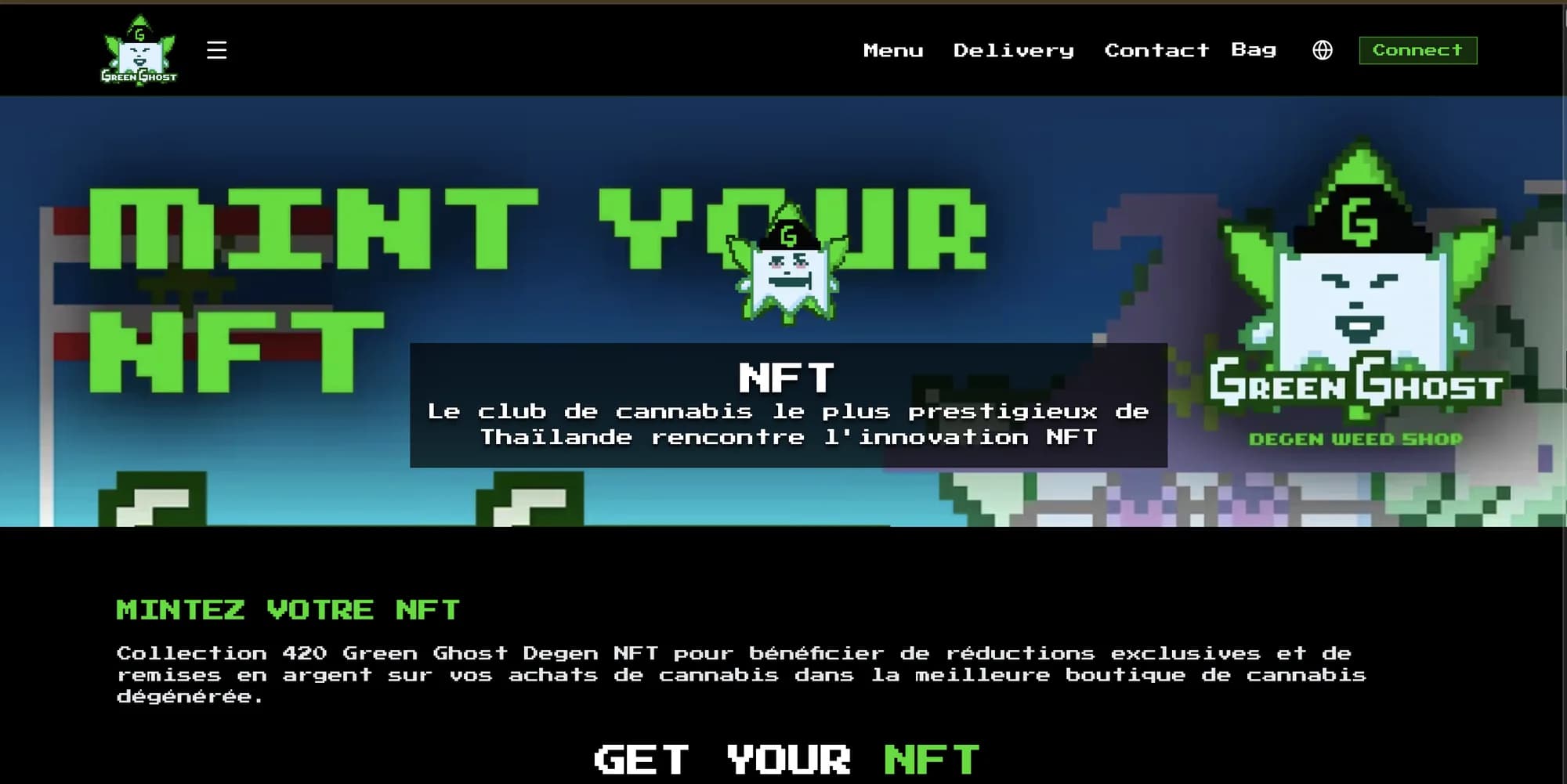

Crypto and NFT
Green Ghost: cannabis, crypto and NFTs in Phuket
Phuket, Thailand
I worked for Green Ghost, a cannabis shop with delivery in Phuket, Thailand, that brings cannabis and crypto together.
Its NFT collection “420 Green Ghost Degen” is minted by connecting your wallet on the website: each NFT gives access to exclusive discounts and cash back on purchases from the shop.
- NFT collection
- Wallet connection
- Thailand
Who crypto payment is for
Businesses that get paid in crypto
Your revenue comes in as USDT or USDC? Pay for your website with it, without converting to euros and paying bank fees.
Entrepreneurs outside Europe
In Africa, Madagascar, the Middle East or Asia, international bank transfers are slow and expensive, and cards are often declined. A stablecoin arrives in minutes.
Freelancers and digital nomads
Freelancers, creators, consultants paid in crypto by their own clients: your website is paid for in the same currency.
Web3 projects
A community, a digital product, a decentralized app: you need a fast, modern website and a provider who understands how you pay.
The websites I build, all payable in crypto
The type of website depends on what you sell and how you want to manage it afterwards. All my website packages can be paid in cryptocurrency.
Business website
Present your business, services and work, and turn visitors into contact requests. Written for SEO from the very first page.
Website designShopify online store
Catalog, checkout, shipping, automated emails: a store ready to sell, which you then run on your own.
Shopify storeOdoo website
Website, invoicing, inventory and CRM in one tool, for businesses that want everything in one place.
Odoo websiteLanding page
A single page, designed for a Google Ads or Facebook Ads campaign, with only one goal: conversion.
Landing pageCustom website in Next.js
For projects that need performance, a custom interface or a web application. It's the technology behind this website.
Custom website3D and WebGL experience
3D animations, rotating products, interactive scenes in Three.js: the look many Web3 projects are after.
WebGL scenesNeed a brand identity too? I handle logo design and SEO optimization on the same payment terms.
Accepting crypto on your own website
If you pay in crypto, your customers will probably want to do the same. An online store or a booking website can accept cryptocurrencies alongside cards, through a payment gateway. Here are the four solutions I set up most often, depending on how much control you need and your platform:
BTCPay Server
Open-source software installed on your own server. No middleman, no commission: payments go straight to your wallet. The bitcoin purists' choice.
Coinbase Commerce
Coinbase's own solution. It accepts the main cryptos and stablecoins, with ready-made plugins for Shopify and WordPress.
NOWPayments
A gateway that accepts several hundred cryptocurrencies and can automatically convert payments into a stablecoin.
Stripe and stablecoins
Stripe has opened USDC payments to some of its merchants. If your account is eligible, crypto is added to the same checkout as cards.
The right choice comes down to three questions: do you want to keep the crypto or convert it straight into euros, are you willing to depend on a middleman, and which platform does your website run on. We decide together during scoping.
How a project runs
- Step 1
Scoping
A conversation to understand your business, your customers and what the website needs to deliver: calls, sales, sign-ups.
- Step 2
The quote in euros
Pages, features, timelines and price, with staged payments set out in the quote. Each stage is paid in the crypto of your choice.
- Step 3
Mockup and development
You approve the structure and design, then the website is built, filled with content and tested on desktop and mobile.
- Step 4
Going live
Domain name, hosting, tracking tags, Google Search Console: the website is delivered ready to be found.
Pricing: the same price as in euros
Paying in crypto costs no more. Each website is priced on quote, based on the number of pages, the features and the content to produce. Only the landing page has a fixed price: €1,200 excl. VAT.
The quote is issued in euros. At each payment, you receive the equivalent in the cryptocurrency you chose. Blockchain network fees are paid by you.
Once the website is live, you can also send it traffic with Google Ads and Facebook Ads advertising paid in crypto.
Accepted cryptocurrencies, and which one to choose
Not all cryptocurrencies are equally suited to paying for a service. There are two families: stablecoins, whose value tracks a traditional currency (the dollar, the euro), and volatile cryptocurrencies like bitcoin or ether, whose price changes constantly.
For an invoice, a stablecoin is almost always the best choice: you know exactly what you're paying, and nobody loses money because the price moved during the transaction.
Tether (USDT)
The most traded stablecoin in the world, widely used in Africa, Asia and by international advertisers. Its value tracks the US dollar: the amount sent is the amount received, with no exchange-rate surprises.
USD Coin (USDC)
Issued by Circle, licensed as an electronic money institution in France. It's the stablecoin that complies with the EU's MiCA regulation, the one European platforms offer by default.
Bitcoin (BTC)
The first cryptocurrency. Its price moves sharply from one hour to the next: the amount to send is calculated at the time of payment and stays valid for a limited time.
Ethereum (ETH)
The second-largest cryptocurrency by market cap, and the network on which a large share of stablecoins circulate. Same rule as bitcoin: the amount is locked at the time of payment.
The network matters as much as the crypto
The same stablecoin runs on several blockchains. USDT, for example, exists on Tron, Ethereum and Solana: these are different tokens, with different fees. The network is stated on every invoice, and you must use it exactly as shown.
Tron (TRC-20)
Low fees and fast confirmation. The most common network for sending USDT.
Ethereum (ERC-20)
The original stablecoin network. Higher fees that vary with network congestion.
Solana, Polygon, Base
Very low fees and fast confirmation. Increasingly used for USDC.
What European regulation says
Since the MiCA regulation came into force, exchanges serving European customers must be licensed, and only certain stablecoins are allowed on them. USDC (and its euro equivalent, EURC) is compliant. USDT has been delisted from European platforms for customers in the European Economic Area, but remains the most widely used outside Europe.
Paying an invoice in crypto is perfectly legal: the service is still invoiced in euros by a French company, and the crypto is simply the means of payment. On your side, however, exchanging cryptocurrency for a service may have tax consequences. Ask your accountant how to record it.
How a crypto payment works
- Step 1
You receive the invoice
An invoice in euros, issued by my company, with the amount excl. VAT, any VAT due and the equivalent in the cryptocurrency you chose.
- Step 2
You choose the crypto and the network
I send you the wallet address and the network to use. Always check both: crypto sent on the wrong network is usually lost.
- Step 3
You send the payment
From your wallet or your exchange (Binance, Coinbase, Kraken, Bitget…). Network fees are paid by you.
- Step 4
I confirm receipt
As soon as the transaction is confirmed on the blockchain, I send you an acknowledgment of receipt and the work begins.
Frequently asked questions
Can you really pay for a website in cryptocurrency?+
Yes. The quote and the invoice are issued in euros by my French company, and you pay the equivalent in USDT, USDC, bitcoin or ether, at the rate on the day of payment.
How much does a website paid in crypto cost?+
The same price as a website paid by card or bank transfer. Each website is priced on quote, based on the number of pages and the features. A landing page costs €1,200 excl. VAT.
Which cryptocurrency should I pay with?+
Preferably a stablecoin: USDC or USDT. Their value tracks the dollar, so the amount sent matches the amount invoiced. With bitcoin or ether, the amount is calculated at the time of payment.
Can you add crypto payments to my website?+
Yes. I can connect a gateway such as BTCPay Server, Coinbase Commerce or NOWPayments to a Shopify store, a WordPress site or a custom website, so your own customers can pay in crypto.
Do I get an invoice?+
Yes, for every payment: an invoice in euros with the equivalent in the cryptocurrency used, which you can hand to your accountant.
Will the website rank well on Google?+
The website is built for SEO: page structure, tags, speed, mobile version and structured data. To gain rankings over time, SEO optimization continues after launch.
I'm not in France, is that a problem?+
No. Paying in crypto is precisely the simplest option for clients outside Europe. We talk by video call, email or WhatsApp, in French or in English.

Your website, paid in crypto
Describe your project and the cryptocurrency you want to use. I'll reply with a quote in euros and the payment terms.